Mizugakiyama
Last fall, I found myself suddenly confronted by a lot of chaos.
The story is tragically mundane. Like so many people, the totality of anxiety and insecurities that I had absorbed and nurtured during the first few decades of my life became suddenly overwhelming. It took only a few near catastrophes for me to recognize the problem, and by then it was too late.
My approach to fixing things was also the stuff of textbooks, but the doctors, breathing techniques, and so on produced too many dead ends. Turtles all the way down.
So, when I reached the new year with no answers, I sought to make sense of things at the top of a mountain. Where I always seem to make more sense. Where, more often than not, I can find clarity.
That’s what brought me to seat 15D on the Azusa Express on a cold, gray morning in January.
With Azusa as my legs, I was charting a course for Mt. Mizugakiyama. Mizugakiyama is one of the 100 most majestic mountains in Japan, or Hyaku-meisan. It’s a somewhat arbitrary designation, but Mizugakiyama felt like the perfect challenge for this particular point in my therapy. For one, it sits far from the beaten path, and even farther from my apartment in Tokyo. It’s also situated near a very minor onsen, Masutomi Hot Springs, which is one of a modest few radium baths in the world. The remoteness and relative obscurity of both Mizugakiyama, as my primary destination, and Masutomi, the reward, appealed to my personal conviction that if anything is therapeutic in any way, it has to require a bit of effort. I’m not looking for some easy self care. This is a project.
Indeed, Mizugakiyama and Masutomi would require some effort. The area is not reachable by train, in the first place, which meant I would have to put in some mountain driving. To complement its inaccessibility, the region was under a cold spell this particular weekend, and I could expect much of the trail to be under ice. That challenge excited me particularly. Like a stoic monk taking secret pleasure in his flagellation, I always hope for sunshine and revel in rain.
The Azusa departed Shinjuku toward Kofu Station at 9:00 a.m. sharp. The sky was sinking, gray clouds hanging low and starving Tokyo of sun and warmth. I was outfitted for winter — a wool baselayer squeezed my legs, a heavy fleece softened the weight of my pack, which was filled with emergency supplies and some food.
Azusa made quick work of the Tokyo rails, delivering me to Yamanashi in under an hour. It took a bit longer to escape the heavy clouds, though. I had my first taste of sun about 20 minutes out from Kofu, where I was to deboard and pick up my rental car.
When the sun finally emerged, the earth took on a different character, its distant wisdom displaced by welcome and willingness as the sky opened up and allowed some warmth in. Under a cloudy winter sky, bare trees stretch their limbs in awkward and eerie angles. They look exhausted. A bit of sun chases away their exhaustion, beckons them to rejoice and dance. Of course, it’s all a matter of perspective, but it’s quite a marvel how quickly a person’s perspective can change on this kind of thing as mine did in the last minutes of my time on the Azusa.
The sun was chasing out some of my exhaustion, too. I was up late the night prior, nursing some wine and gorging myself fat on cookies — the latter another symptom of my particular condition, I tell myself to absolve myself of any fault in the soft layer I had nurtured around my waist over the past month or so.
Still, my body would need more than a bit of sun to arouse it from its stubborn dragging. That would require some coffee, a remedy I was holding off for a cafe in Kofu I wanted to visit, Akito Coffee.
Akito was worth the wait. The storefront looks modest, situated along one of four main arteries that run outward from Kofu station like lines on a compass. The smell of beans roasting lifted my feet and carried me through the door.
The attendants at Akito were warm. They talked about the roasts they were serving, asked why I had come to Kofu. I told them that I was making the hike up Mizugakiyama. One of the attendants was a fellow mountaineer, so we shared some quick stories while he dripped my single-origin Kenyan. They asked about my camera, where I was from, and so on. Sure enough, the brew and ebullience at Akito was just what I need to set my sights on the climb ahead.
The drive from Kofu to the Mizugakiyama trailhead takes a little over an hour. It seems a lot shorter, though, as the majesty of the Akaishi Mountain Range keeps the mind from becoming too idle or distracted. Before too long, I was parked at the trailhead and getting my things together for the hike ahead.
By the time I was on the trail, the sun was already low in the western sky. It was only just after noon, but sunset was forecast for around 4:30 p.m. I estimated the course I had chosen would take about three hours on the ascent and two back down, so I was already expecting to spend some time in the liminal light of a dusk trail. As I assessed the tree cover and surrounding hills, I realized shadows would overtake the trail even sooner and felt a bit worried about getting stuck in the dark.
The first leg of the hike was a mostly unmarked patch of woods, and it didn’t do much to put my apprehension to bed. I had my headlamp and plenty of provisions, just in case I was stuck on the trail for the night, but I was beginning to wonder just how much warmth an emergency blanket could provide. The thing about an emergency blanket is, the owner would typically prefer that it remains unused.
After 30 minutes on the trail, I was feeling committed to the project again. Crisp air filled my lungs, cold sweat licked my face. The consistency of the ground changed noticeably with every 200 steps or so as the temperature dropped and dry, winter soil became hard ice and frozen earth. By the time I reached Fujimidaira Lodge, a small campground and lodge at the main fork, there was more ice than soil or stone. Getting by without crampons had become tough, so I sat on a stump to strap mine on.
Fujimidaira has a lot of charm. A hand-painted sign advertises the house ale. A large tank is marked by a sign indicating it to be an experimental wastewater recycling station. Despite the cold, there were a handful of campers setting up bivouacs for the night. Unfortunately, the lodge seems to be unmanned in the off-season. I imagined what it would be like to come here on a summer night, to enjoy a cold local brew and listening to owls stirring to hunt. I made a note to return again in a warmer time.
After topping off my canteen with some fresh spring water, I started back on the trail. The sound of my crampons biting at stones that dotted the areas of the trail that weren’t under ice broke the cold air’s silence. It was a short and fairly easy climb to the trail’s first resting point, an overlook that faces the Mizugakiyama peak in the distance.
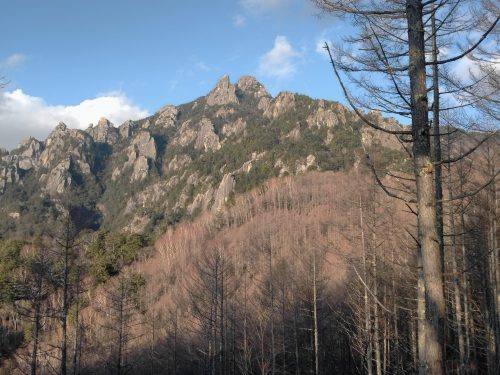
Jan. 2018
Digital
The trail to the main ascent led from the right, away from the resting point, and wrapped around in a 2-kilometer loop. From here, the ascent looks modest on the map, but it’s steep. I took a moment to double-check the map, throw back some dark chocolate for energy, and drink a few gulps of near-frozen water from my canteen. Then it was off.
The first kilometer of the main leg was something magical. I walked through a low valley, dark and frozen, that cuts through a marsh to the left and steep foothill to the right, behind which the sun was resting. I lost and regained my balance walking over the alternating patches of rock and ice. Sweat on the exposed areas of my face made me shiver, even as my base layer kept me hot.
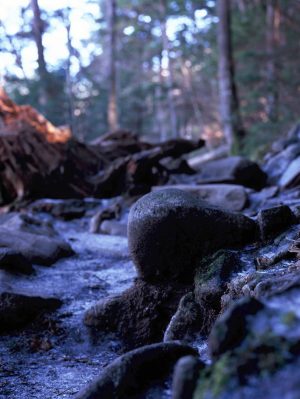
Mizugakiyama, Jan. 2018
Fujifilm Velvia 100
I took my time in this part. I stopped my feet every time I caught a glimpse of sunlight spilling over the high walls and through the trees, narrow streams of rolling heat that bent around the branches and reached to the ground of the valley but never quite arrived.
When I finally emerged from the valley, my eyes needed a moment to adjust to the bright sun. A river cut perpendicular to my path, frozen in time. But the intermission was brief, as the path returned to valley on the other side of the water.
From here, the climbing becomes more aggressive. Chains hang from icy rock faces, a tether for hikers to hoist themselves up. The trail is lost under snow in parts, so I search for cairns and for red flags hanging here and there to mark the way up. Fellow hikers’ grampons make pockmarks in the snow at softer parts in the trail, and I attempt to use these when all other indicators are missing.
Around 45 minutes from the creek, I ran into the first hikers since the camping area. That they were working their way down reminded me that I was concerned about how much sunlight remained. I glanced at my watch — just after 14:00.
“Much farther to the top?” I asked casually.
“Shouldn’t take another hour for you.”
I performed a bit of quick math — with 45 minutes to the top, and maybe two hours on the return, I could be back off the trail just after sunset. We’re keeping good pace. And anyway, if working my way through last leg of the return trail at night is the price for dawdling, it would be a price worth paying, I told myself.
Just in case, I picked up my speed a bit.
The final ascent is steep and requires some climbing skills, aided by chains in some areas and bare in others. The sun was hitting this area of the hills, at least in the parts that don’t sit in the shadow of the substantial boulders that make Mizugakiyama such a draw for climbers in a slightly warmer season.
As I entered the last 300 meters of the trail, where the ascent levels off, I found myself in a pristine, snow-covered clearing. It was deeply, beautifully quiet, so much so that I could hear the earth stirring in its frozen sleep under the weight of its cold, white blanket.
This part of a trail is spiritual for me. My legs coarse with hot blood, my clothes are soaked in sweat, but the challenge sits behind me. I call the mountain my equal and hope she sees me the same. I took my time here as I approached the top of Mizugakiyama. I let me feet engage the snow. I walked and knew I was walking.
On the other side of the clearing, interrupted by a few snow-covered ladders, I saw the afternoon sun hitting the ground. I emerged from the trees, and into the sun’s heat that showered the summit.
I loosened my pack to the ground, stripped off my outerlayer, dropped my gloves, and stood for a moment surveying the view. An uninterrupted horizon of mountains surrounded Mizugakiyama on all sides. The snow at my feet contrasted with the distant tapestry — the deep evergreens, the brown of the naked branches, the gray of the shyly exposed rock, and the blue of the January sky.
Just as my watch was turning to 15:00, I rallied the energy to put the summit behind me and confront the descent to the trailhead. I made haste going down, probably more than one should on steep, icy stone. Some of the mid-sized boulders presented the biggest challenge. The smaller ones can be jumped, and the larger ones have chains. For the mid-sized boulders, I had to lower myself onto snowy ground. One of the big dangers in this scenario is that the path below could be uneven, and that landing on uneven ground could really do a number on an unwitting hiker’s ankle.
Luckily, I found my way down in quick time and without incident. In fact, by the time I reached the creek around 15:45, I had caught up with the hikers I met on my ascent. They laughed at how quickly I made the descent, and I laughed with them.
Being convinced that I was in the clear to get back to my car before sunset, I decided to take a break at the river and set about brewing a cup of coffee. I rested my burner atop a sheet of ice that in a time long ago was flowing, churning. With a few clicks, the burner was spitting hot blue flame.
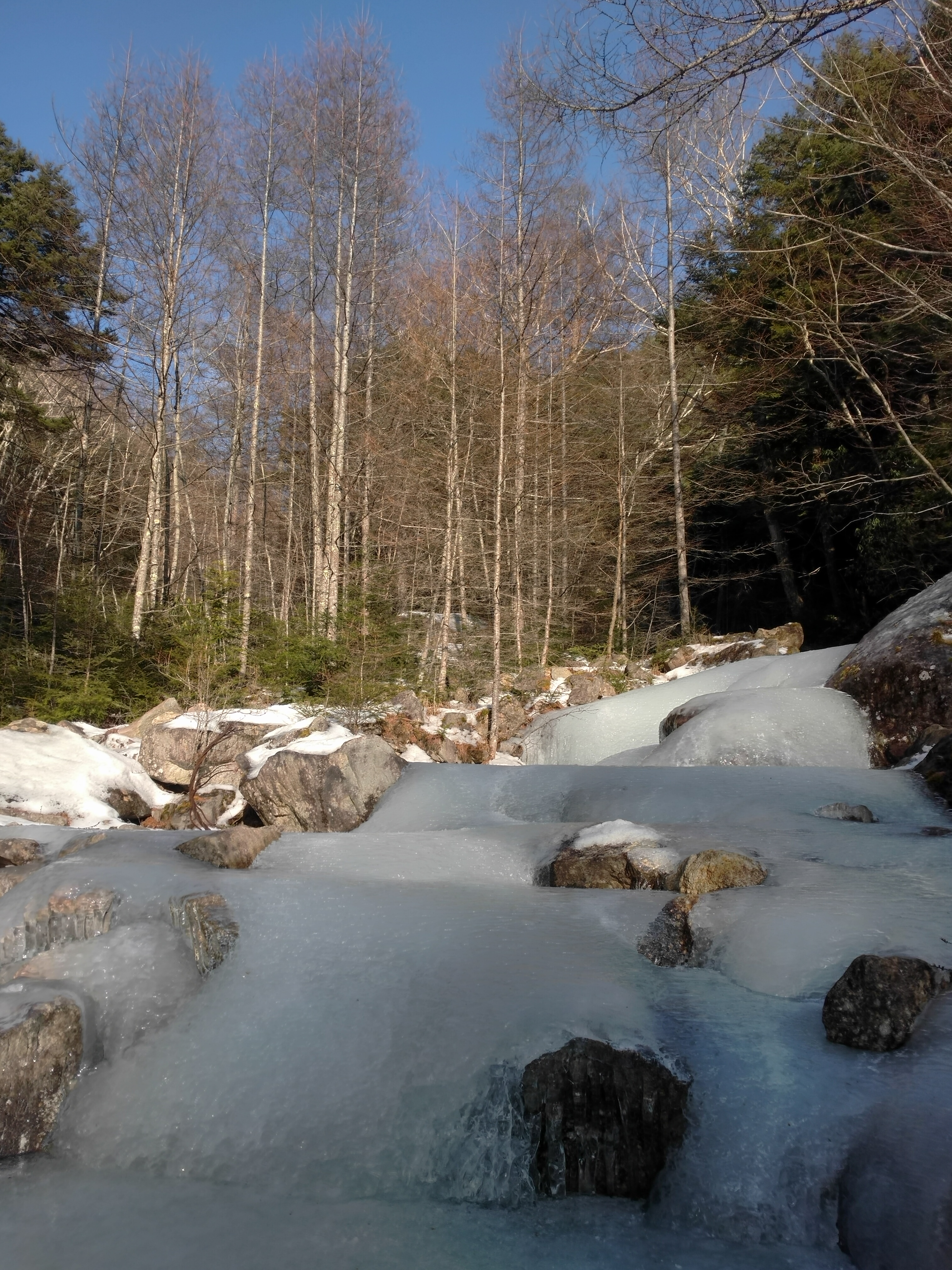
Mizugakiyama, 01.2018
Digital
I emptied the last 8 or 10 ounces of water from my canteen into my boiling pot, felt the heat of the flames lick my cold fingers as I moved the pot to the burner. The surface of my frozen workspace melted slightly, waking from slumber a few small streams that made it only a few inches before freezing again. When the pot reached a boil, I removed it with a gloved hand, turned the valve to close the gas release, and emptied the contents into my brewing bag. It takes a few minutes to steep, so I filled the quiet time reflecting on the summit. When the hot brew was ready, I poured it back into the boiling pot and drank in slow, deliberate drags.
The coffee warmed my stomach and fueled my legs for a quick walk through the final part of the return trail. The sun settled into the hills just as I arrived at the camp, and the sky was well beyond dusk by the time I reached my car around 17:00.
My second destination, Masutomi hot springs, was a short drive away. At this time of the off-season, I expected the baths at Masutomi to shut their doors early, so I tried to avoid wasting time in the parking lot. I stripped my outerlayer, exposing a sweat-saturated base to the crisp early-night air of the mountains. From the driver’s seat, I hanged my legs out the door and drank the distant peaks once more. Then, without any ritual in particular, I was off.
The drive to Masutomi was uneventful. I listened to Nick Drake as my car snaked its way through the mountain roads. As I parked my car outside my accommodations for the night, a tiny minshuku boarding house called Geiketsu, night had already enveloped the mountains.
When I entered Geiketsu, I was greeted by an old dog. The dog seemed unwittingly to alert the proprietor to my arrival. She was a kind woman, maybe in her 60s, with a warm smile and a soft but projecting voice. I told her I was sorry to be arriving so late, but she didn’t give the sense that she minded. She said the main bath would be closing at 18:00, so I had only 20 minutes or so to get in the door. We decided a time for dinner and I thanked the dog for alerting the inkeeper, scratching him behind his ears.
At the bathhouse, I was reminded by the clerk that closing time is 18:00 but told not to rush. I thanked her for the hospitality and, behind the curtains, stripped my baselayer.
My muscles tensed and cramped as I sank into the lukewarm bath. Masutomi is rich in radium, joining the dozen or so naturally radioactive hot springs around the world. The benefits of low-level radiation therapy are controversial, at best, and a person accepts certain risks when bathing at a place like Masutomi. My tired body was happy to assume that risk. After the cramping passed and the feeling of earth on my soles dissolved into the muddy water, I found myself able to reflect for the first time since the summit.
I had come to Mizugakiyama to make sense of things. On the mountain, I didn’t find a Rosetta Stone to bring order to all the chaos. There were no epiphanies, no life-changing decisions. I did find something, though. It was elusive, to be sure, but present. It was feeling of belonging. The chaos hadn’t dissipated, but somehow, within it all, I made sense.
That night, my sleep was deep and dreamless.