Kenya
In a finite world, there is a particular value to the last of anything. The drunk and drinking crowd sobers to a world of limitations at last call. Donna Summers croons about the last dance, her “last chance for romance tonight.” A man on his last nerve may give his last warning before it’s the last straw.
Modern life in an advanced economy offers protection from the finite. When consumption is fashionable, success and wealth are interchangeable, and the whims of any moment can be satisfied with the click of a button and overnight or two-day shipping, it’s easy to live without paying mind to whether any thing or experience is our last. Sustainability and conservation make wonderful topics of conversation, yet with modest effort one is able to shield oneself from the strangle of scarcity.
I went to Kenya to meet Najin and Fatu, the last of the northern white rhinoceros subspecies. Najin and Fatu are both female, and there is limited likelihood that planned in vitro fertilization efforts will succeed, making the subspecies functionally extinct. Could there be more fitting a symbol of our collective ignorance of scarcity than the virtual poaching to extinction of these animals for short-term gains, immediate paydays?
Najin and Fatu are kept under constant protection at Ol Pejeta nature conservancy, so that became the first destination of my Kenya visit. Getting there was an incredible feat. The journey from my apartment to the Ol Pejeta campsite took more than a full day. Joined as ever by M, I flew first to Ethiopia via Seoul, changed planes there, then flew on to Nairobi. At Nairobi, I met up with Naomi, who had planned my itinerary, and Paul, my driver. “He has such crazy love for the rhinos,” Naomi told Paul by way of introducing me. With that, Naomi sent us off for a five-hour drive northwest.
On the road to Ol Pejeta, I quickly learned that scamming tourists is something of a pastime for Kenyans, and that shelling out shillings for junk would become a theme of my trip. At a pit-stop curio, I was foolishly scammed into buying a softball-sized wooden elephant for about 30 dollars in what I convinced myself was a great act of charity. Later, at the point where the road to Ol Pejeta passes over the equator, an enterprising local who calls himself Professor MacKenzie, academic credentials dubious as they may be, offers a science demonstration to tourists for 500 shillings. In the demonstration, the professor pours water through a funnel on one side of the equator to show that water drains a certain direction. Then the professor moves to the other side of the equator and repeats the demonstration, and would you believe it, the water flows the opposite direction. It’s science, pay up!

The scamming left a sour taste, but I otherwise found great amusement in the general informality of the Kenyan people. At one point along the way, Paul stopped at the city of Karatina for a personal errand. He left the van for ten minutes or so, and came back with a ball of purple fabric. He threw the fabric into the front passenger seat and said, “I bought a shirt.” At a loss for how to respond, I let that particular conversation die, but the episode gave me a different idea of him, humanized him, and it stuck with me the rest of the trip.

The camp at Ol Pejeta was a kind of luxury tent village. I arrived just after sunset and got ready for dinner. Gazelles grazed on a vast field that stretched out from my tent. Mt. Kenya stood in the distance, majestic and cryptic. Stars were emerging above like a choir of children, an embarrassed few voices growing to a louder chorus. By the time I returned to the cold night air after dinner, the sky above me was the deepest black ocean adorned with a veil of stars.
I awoke around 5:30 the next morning and left my tent to watch the big African sun emerge from its slumber. A rhino was taking water from a pool just meters away from me. Big-eared bats performed aerobatics around the camp and cheeped as they zoomed about in the last moments of darkness, hurrying to nowhere. Cuckoos began their songs in the distance. I stood in silence, meditating and absorbing the wild earth’s energy, energy that seemed like it was from a time before man, an eternal energy that would outlast us. The thundering of hooves, sudden and angry, broke my meditation as a gazelle ran directly behind me. I turned, just after the gazelle had passed, and caught view of it from behind. Massive antlers, taut neck, all muscle and sinew. The journey to Ol Pejeta was so long and exhausted me so thoroughly that I hadn’t taken a moment to appreciate how different this world was from my own.
After I took a breakfast of muesli and strong coffee, we began a tour of the conservancy. The air was cool and crisp at this elevation. I stood with my upper torso above the roof as the van lumbered along the path, stopping occasionally for a crane or zebra or giraffe.
After an hour or so of aimless exploration, we arrived at a cemetery of rhinos. Grey gravestones sprung from dry soil like jagged teeth. Among them is a stone for Sudan, the last male northern white rhinoceros. In nondescript yellow letters, it reads as follows:
SUDAN
1973-2018
I asked Paul if 45 is old for a rhinoceros and he told me it is. I wondered if it mattered to Sudan that he was the last male northern white. Did he cling to life in his old age? Was his longevity reflective of some obligation to his subspecies or was this observations just arbitrary and anthropocentric on my part? Thoughts like this came and went until my mind finally quieted, as though I had completed a conversation and couldn’t find a new topic.
I took a picture of Sudan’s grave. One thing I adore about film photography is it encourages the photographer to ponder the subject. I focused my lens on the bright yellow letters, adjusted the shutter speed and aperture settings for the light and mood. I was present. I was with Sudan. This one was for me.
Before leaving, I rested my hand on the gravestone and said a silent prayer to Sudan.
After the brief spiritual respite, we continued to the rhino reserve for a guided tour. I was disappointed to discover that Najin and Fatu can only be met by appointment, which I didn’t have. That seemed appropriate, though, in some distant way I can’t quite explain and don’t quite understand. Instead, I met a black rhino called Baraka, which the guide told me means “blessing.” He was fully blind, but apparently he gets around well due to a superior sense of smell.
After the rhinos, we visited a chimp reserve and made a few friends. Poco likes peanuts, Max is a troublemaker. We finished the morning with one final game drive, then headed back to the camp for a quick lunch. With bellies full, we were in the van again to make our way to the second safari destination, Samburu.
It was another long drive to Samburu, and the elevation and climate fluctuated violently along the way. The warm, sunny plains of Ol Pejeta gave way to a cold rain as the van climbed mountain roads. The temperature rose after the rain passed and the sun emerged. I waved to kids along the road and invariably they waved back. One girl blew a kiss. I marveled at the universality of human communication.

We pulled into Ashnil Samburu Camp around the same time of day that we had arrived at Ol Pejeta, with about an hour of sunlight left. It was a bright, gorgeous sun, too. We used the remains of the day to go through the motions of one more game drive. Along the way we saw a herd of elephants. I took some pictures, was charged at by a momma elephant protecting her calf. The air was hotter and drier than Ol Pejeta.

The Ashnil Samburu Camp was more remote than Sweetwater and so had fewer trappings and amenities. Hot water was available only at certain hours, the electricity was even more precious a resource. Yet another reminder of scarcity. Locusts, on the other hand, were abundant on the camp grounds. They covered every surface, bounced off every light. Indeed, a plague a locusts.
The Kenyan national beer is Tusker. I learned the locals call it elephant soup. At any rate, I drank one while organizing my experiences and memories from my first full day in Kenya. With no electricity for miles and no moon in the sky, the night in Ashnil Samburu was the blackest I’d ever seen. I slept soundly in the comfort of dark and drink.
Game drives continued the following morning, turbulent cruising interrupted here and there by opportunities to gawk at a pack of impala or oryx, ostriches or zebras. Giraffes were a rarer treat.

At mid-morning we made our way to Archer’s Post (no relation) for a visit with a Samburu tribe. This turned out to be a surreal experience. I tried to approach with an open mind, but found myself generally objecting to the visit on principle because it felt a bit like poverty tourism. The Samburu people have found ways to monetize so many aspects of the tribal tour — a few thousand shillings for the children to sing a song, an impromptu market of handmade goods laid out on blankets for purchase. The weight of colonizer guilt won out and I attempted to absolve myself with some shillings here and there, but generally I felt uncomfortable. The impromptu market was the most acutely uncomfortable portion of the visit. The tribe’s sole English speaker haggled with me over the price of beaded bracelets and necklaces that I didn’t need or want, and the price was invariably little more than I would spend on a lunch in Tokyo. Despite myself, I am glad to have had the experience. Sometimes travel is uncomfortable, and those moments can be a great source of growth.

After visiting with the people of Samburu, I used a few hours of free time to have lunch, nurse some cold Tuskers, and read. Camp staff walked around shooting stones at monkeys with slingshots, which felt a bit cruel, but I guess it’s the culture. At mid-afternoon, Paul brought the van around for another game drive. Afternoon turned to dusk, and dusk turned to night, and like that the day ended.
We performed an en route game drive early the next morning as we set out for Nairobi. We saw two beautiful silver-backed jackals feeding from a brook and stopped to admire them. Paul reluctantly let me out to take a picture of the turtle and feel the Samburu soil under my feet one last time.
The road to Nairobi took about nine hours. A flat tire set us back an hour or so in Karatina, where Paul had bought a shirt on day one. I ate a packed lunch at a milk bar and watched people come and go. Goats fed on trash, colorful motorbikes lumbered this way and that under the weight of two or four passengers. The proprietor of the milk bar, a woman around my age, watched me load a new roll of film and asked what I photograph. Nature mostly, I answered. As I left, I passed her 100 shillings to thank her for giving me a place to rest and sharing some conversation with me.

The rest of the drive to Nairobi was mostly uneventful. At my request, Paul stopped by Nanyuki Spinners and Weavers, a so-called “self-help” weaving cooperative that helps women of limited economic means. We had a brief tour and I bought a scarf. Then we were off.
As we approached Nairobi, Naomi called Paul and asked to talk to me. I told her the trip was fantastic and heaped praise on Paul. When she asked about the rhinos, I reluctantly told her that we weren’t able to see them. “So we’ll be back for Najin and Fatu!” I wondered if that was true.
When we finally arrived at our hotel in the Westlands region of Nairobi, the late afternoon sky was cloudy and heavy. I thanked Paul and shook his hand. I regretted later that I didn’t ask to have a picture with him. He was an important part of my experience and my small tip probably didn’t convey that sufficiently. Again, a squandered last experience.
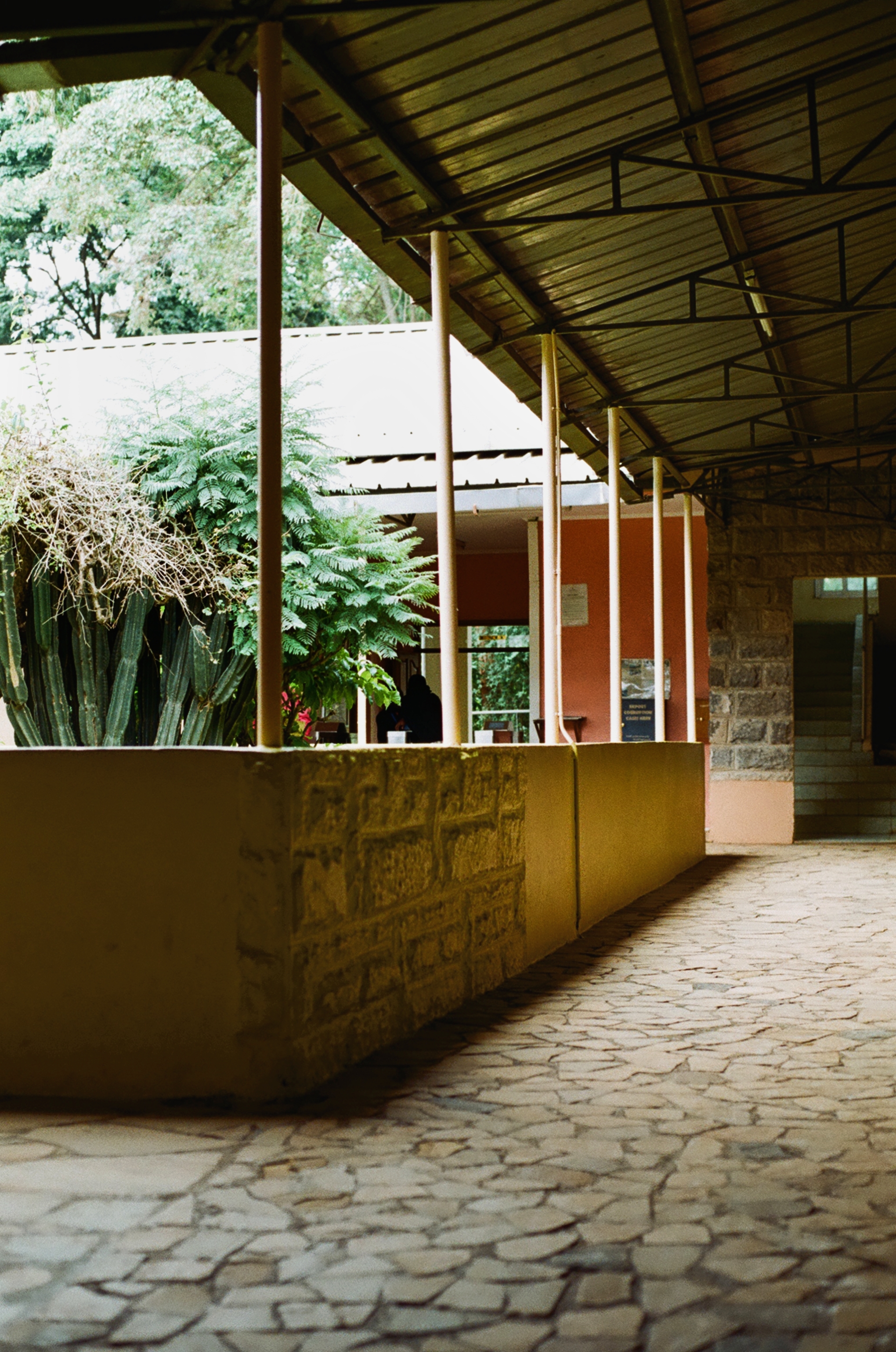
Before heading back to Tokyo, I took two nights in Nairobi to see a different side of Kenya. I ate good food in places the locals can’t afford with a lot of people who looked like me — aid workers, perhaps, making a comfortable living supporting massive multinationals exploiting the legacies of colonialism for profit.

Nairobi was dynamic, a city where solid and sustained economic growth is fueling the construction of high rises and luxury hotels. I wonder if Kenya will learn the lessons of growth soon enough. I wonder if short-term material gains will blind them to the finite nature of our resources, the diminishing biodiversity of Africa’s mountains and plains, deserts and lakes.
Was this my last opportunity to see Najin and Fatu? My last opportunity to do a safari at all?
Will our natural world be the pure and eternal sea of stars in the night sky of Ol Pejeta, or the dusty and unforgiving streets of Nairobi?
*NOTE: Air travel is a significant carbon emitter. To compensate for the carbon impact of my round-trip travel to Kenya, I purchased offsets using carbonfund.org. Offsets are imperfect, at best, and many of the projects supported by offsets, like reforestation and solar panel installment, take decades to compensate for the carbon the purchaser has put into the atmosphere. Caveats aside, it’s one of the better options to consider for your next journey.
Update: July 6, 2018
This week, Nature Communications reported that a team of researchers has made a small but important step forward in efforts to restore the northern white rhinoceros. Surrogates will be implanted with fertilized hybrid southern-northern white rhinoceros embryos in the coming months. If that proof-of-concept attempt is successful, the researchers will appeal to the Kenyan government for permission to extract eggs from Najin and Fatu.