Bikepacking Oregon
Day 1 — The Escape
By the time I shouldered my pack and set out from the room I rented in Portland, the sky had gone gray with heavy cloud cover. I was departing later than I had planned, but I didn’t adjust my pace to get back on schedule. One of the reasons I had come out here, after all, was to escape my Tokyo routine and to get a taste of a life that conforms to my pace — not the other way around, for a change.
I had reserved my gear from a groovy place called Everybody Bike Rentals and Tours, which sits about an hour’s walk from where I was staying. It was late morning by the time I reached it, finished packing my panniers, and settled into my saddle.
Escaping Portland by bike is a bit of a nightmare. It’s a short distance, but the route from the city’s busy Northeast neighborhoods to the Historic Columbia River Highway is a lot of turning and adjusting alongside some major car traffic. My bike swayed and slowed under the weight of panniers full of provisions, water, and camp gear.
In general, Portland has been much more bike-friendly than Tokyo, where drivers are inconsiderate and consistently park in bike lanes, to the extent that bike lanes exist at all. Still, there’s room for improvement even in bike-friendly Portland.
Here, it’s the truckers that present the biggest threat, their massive hauls cutting dangerously close, their angry winds violently pushing me further into the narrow, littered shoulder. It takes me about an hour to get past this and onto the Columbia River Highway, but the mental and physical fatigue makes it feel much longer.
To the rider who escapes beyond the city limits in one piece is given a reward of beautiful natural treasures. The Columbia River Highway eventually gives way to a bike path, and that bike path cuts a route by majestic waterfalls. At its higher elevations, it also offers stunning views of the Columbia River and its surrounds. Even on this gray day, the green banks on the Washington side of the river seemed to glow a deep emerald. My mood was lifted as I climbed higher, making my way toward Hood River.
Despite being behind schedule, it was all I could do to stop and meditate on the beauty of the waterfalls along the way. At some point, the westering sun emerged from behind heavy clouds and sent gold and amber streams through the trees. I had planned to be much farther along my route, but the sinking sun told me it was time to find a place to bivy for the night.
The coming of dusk offered my tired legs and aching muscles an end to their undeserved punishment. To love oneself is to give the kind of consideration to your own well-being that you would give to others. In the saddle, that means resisting the urge to go farther and faster. I often find that urge overwhelming, so it was with some difficulty that I reminded myself why I had come out here in the first place. I told myself I had gone far enough, that there was nothing to prove, and for once it really felt that way.
At Cascades Lock, camp was a bunch of rowdy folks mostly northbound on the Pacific Crest Trail. They were kind and genuine in a way that feels so foreign to me after four years in Tokyo. “We’re all here because we want to be here,” T told me, “and you just don’t find that intentionality in the real world.”
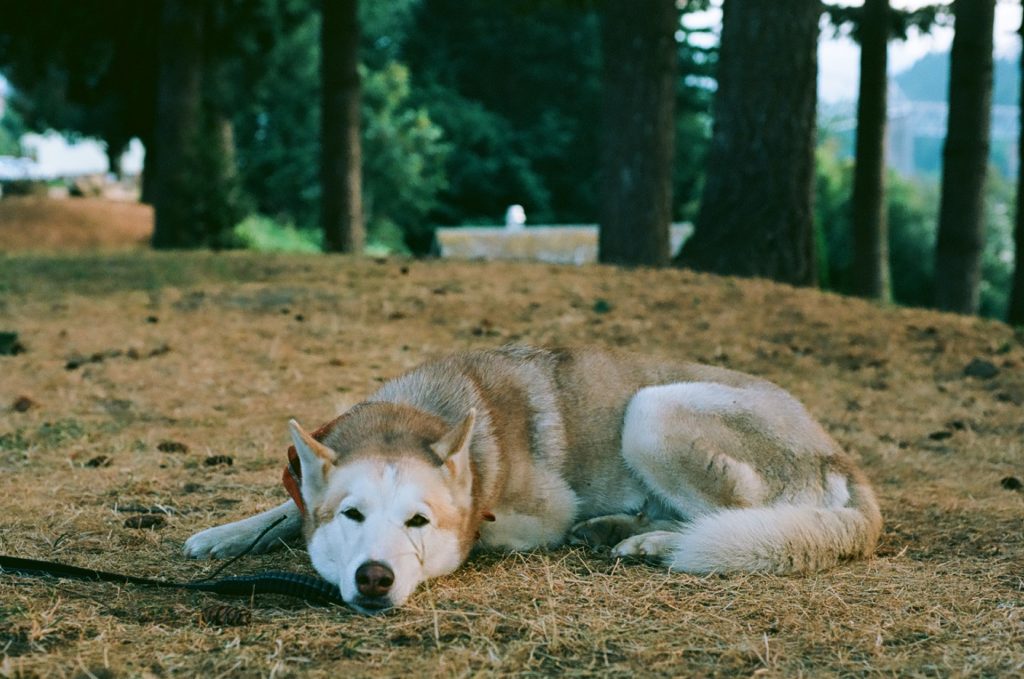
Steve O was the mood-maker of sorts. He quoted Robin Williams lines from Jumanji, and reportedly does a good impression of Eddie Murphy (circa Trading Places era). Kermit seemed shy, but his attentive listening to the various threads of conversation was obvious. When he did speak — which was rare on this particular evening — it felt as though he had been a part of the conversation the whole time. They were welcoming and I felt at home among them.
Cascade Locks sits right against the Columbia River. The air is cool and refreshing. The Bridge of the Gods, now famous as an important landmark in the movie Wild, watches over the campsite. I joined my PCT friends for some conversation, then went for a long walk to drink in the place.
***
Coyote noticed a great commotion on the river banks, where a group of men were hitting at each other and yelling with the kind of furiousness that men are known for. He rowed in to inquire as to the cause of the quarrel.
“Stop tearing at each other for a moment,” Coyote pleaded, “and tell me what all this is about.”
“None of these skunks knows how to catch a fish,” said one.
Another retorted. “We do so. We know full well, and I would bet you I could pull more salmon from this river in a day than you could in a week, were there salmon to be fished.”
A third man shushed his companions, turned to Coyote, and with earnestness told Coyote of their troubles. He reported that the fish had disappeared from the river, and that they had been without catch for weeks. With nothing to fish here, their families had become hungry and weak.
Coyote felt great sympathy for the men and their families and offered to investigate, for which the men were grateful.
Day 2 — The Climb
When I awoke, The boisterous PCT hikers from the night prior seemed to have been transformed by sleep — the drunk and friendly comrades from the night prior now focused quietly on packing their tents and getting on the trail. I follow their lead and set about my own tasks. In no more than 15 minutes or so, I finished packing, put back some oats and dried fruit, stretched my tight riding muscles, and got my wheels to turning.
The weather was pleasant for riding. From behind the high hills, the sun sent pale, warm rays across a blue sky where small clouds dispersed and meandered lazily. Cool morning mist danced upward from the trees. The toughest slog of my trip was waiting, with 1.3 km of elevation gain over an 80 km ride, so I was glad to be blessed with such fine conditions.
A local woman told me the night prior that the new bike trail from Cascade Locks up to Hood River was a treat, and she was right. It was flat and smooth, away from traffic. Even on the steep climbs, it was nice riding with gorgeous views on both sides.
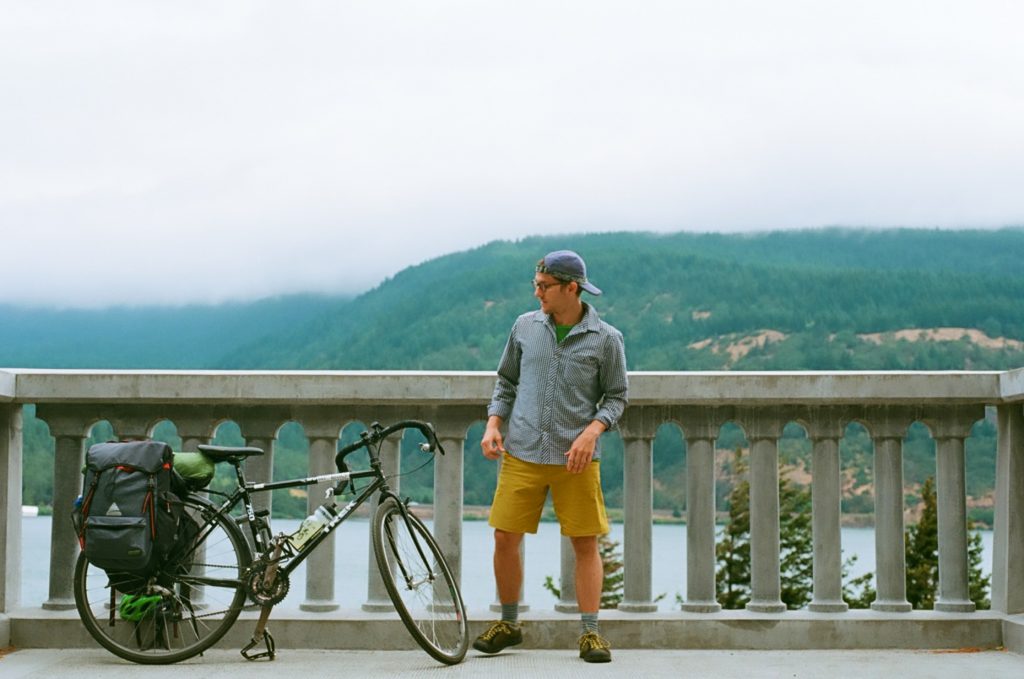
That said, it was hard work making the ascent to Wyeth. I wondered why I do this to myself. Do I love being out here as much as I tell myself I love being out here?
The PCT hikers gave me some interesting insights on this question. Hiking the PCT has been a distant dream for me over the past years. As most were northbound with just a few weeks of hiking in front of them, their sober reflections on the trail were valuable as a kind of cautionary tale. Dreamer beware.
“I’m just tired,” Nigel told me. “These journeys are real work. It’s meaningful work, but like any work, it takes energy.”
As I’m making the ascent to Hood River, I reflect on what meaningful work means to me. I think about family and community. I think about the hard work of loving myself. I think about the importance of being a mindful part of Nature. I wonder if I can accomplish any of these things in Tokyo.
***
Coyote parted with the quarreling men and rowed his way downstream for a time before coming upon three beavers.
“You there,” Coyote called, giving the beavers a start.
“Trying to scare us to death, are you, Coyote?” asked one beaver.
“As you can see, we’re quite busy,” another added. “Unless you’ve got business with us, please be on your way.”
“I don’t mean to intrude,” Coyote said. “In fact, I would like to ask a question if you don’t mind.”
The beavers exchanged glances, then turned back to Coyote and nodded in unison.
“Well, it seems some humans upstream have been unable to catch salmon and have asked me to investigate why there are none swimming here. You wouldn’t happen to have noticed anything related to the fishes’ disappearance?”
“Disappearance?” the largest beaver interrogated.
“No disappearance here, Coyote,” another continued. “In fact, we have schools of them right here below us.”
The third beaver slapped her tail against the roof of the dam, and pointed her paw downward toward the river. “Salmon in abundance, Coyote.”
Coyote looked over the dam and saw that below the water’s surface it stretched outward in a long, uninterrupted mass across the river. Casting his gaze downstream, he saw the scaled skin of the fish below flashing brightly as they danced through the water toward the dam then extinguished upon reaching it.
“Beaverfriends, you are catching entirely too many salmon in this tremendous dam you’ve built. You must make the dam more porous, or –“
“Or what, Coyote? What do you know about building a dam?”
Coyote knew beavers to be quite reasonable — certainly as reasonable as any human he’d ever met, and even as clever as many of his own kind. “It is as you say, beaverfriend, I don’t know much about your work.” Far be it for Coyote to tell beaverfriends how to make a dam.
Coyote did have one area of wisdom about which to mentor the beaverfriends, however. “I do know a good deal about our neighbors, the humans, though. They have been good friends to the river, taking no more than they need and giving the river spirits offerings in return. If their hunger chases them into a corner, though, they will become desperate and may develop a taste for beaver.”
Coyote paused to allow the beavers to sit with this point. They threw about looks of pensive concern, indicating the point had had its desired effect.
“Now, I can go back to the humans and let them know that this dam is the reason they’re hungry. I suppose they may not take too kindly to that. On the other hand, if you agree to fix the dam and to share the river’s blessings with the humans upstream, I will tell the humans a fallen tree had interrupted the salmon’s route. They’ll never be the wiser to the cause of the river’s obstruction.”
The beavers turned away from Coyote and whispered among themselves. Some moments later, they returned to give their response and, accepting Coyote’s offer, asked that the humans be informed that salmon would be returning upstream most expediently.
***
There’s nothing pleasant about the last few miles of highway into Hood River. The bike trail ends abruptly and confusingly just outside city limits, channelling cyclists onto a busy six-lane. Any one of the trucks barreling past me could have hastened my departure from this mortal vessel, so I thank my good fortune when I reached downtown Hood River.
Hood River has the subtle charm of a small town with a good tourist draw. There are funky book stores, welcoming cafes, and Main Street vibes. The sun was hot and rising by this point in the late morning, and the hardest climbs awaited me on the other side of town, so I parked my bike and sauntered into one of those welcoming cafes to rest and rehydrate for the journey ahead.
Mt. Hood greeted me on the other side of Hood River’s steep hills and winding neighborhood streets. From there, it was to be mostly a straight shoot uphill to Sherwood. By the time my wheels got to spinning at a good clip, the sun had gone from hot to hotter. I drained my water bottles in no time and had to make a pit stop at a gas stand about 10 km outside Hood River.
As I was standing in the parking lot by my bike, an older man left his truck and started my way. His skin was stained dark copper by so much time in the sun. He asked me where I was headed, so I told him that I was aiming for Trillium Lake.
“Boy, you got more legs than me.”
“Well, don’t speak too soon on that,” I told him. “I’m not sure my legs are up to the task, to be honest.”
A serious and stern look came across his face. “It’s all about pacing,” he said.
As I crawled along at a snail’s pace on the steeper grades, I had plenty of time to mull over his advice, which I considered a great gift for the encouragement it provided. I’m pathologically eager to get to my destination — happiness, career satisfaction, or any other area of importance in my life. When I realized that my lifestyle in Tokyo was a source of my discontent, I was ready to jump ship immediately and move somewhere more aligned with my values and vision. Maybe the trick to getting there is that it’s all about pacing, I mused and ruminated on the general contours of happiness as I climbed, climbed.
The last 30 km or so of road are tough. Grades averaged 4.0%-7.0%, which in non-scientific terms is “dang steep.” The sun burrowed into my skin and started a wildfire, which my sweat-soaked clothing did little to squelch. I passed Sherwood Campground in the late afternoon and, with the sun heading quickly for the tree-line and a nagging pain in my right knee, I decided that was far enough for the day.
I set up camp under a massive Douglas Fir and in front of a six- or seven-foot drop into the roaring East Fork Hood River. After scoping the grounds and finding no other campers on site, I peeled off my clothes and bathed away my sweat in the river’s cool waters. My calves and thighs contracted violently from the initial shock, then sang a chorus of aahs as the river carried away their fatigue.
With plenty of light left, and feeling refreshed from my bath, I took a walk around the area to greet the trees and forage some berries for dessert. When I returned, a few campers in the neighboring site had also just arrived from a hike.
I got to talking with my neighbors and they offered up some food and clean water — much more refreshing then the sediment-heavy river water I was chlorinating in my reserve bottle. I accepted the water, but felt it would be too presumptuous to take the bars they offered. They insisted. I accepted. A few extra energy bars might could come in handy down the road.
I set a fire as the sun’s light faded, prepared a bit of dinner, and wrote a bit before tucking in. Later, in the deepest hours of the night, I awoke to listen to the river and gaze at the sky. I showered in the starlight of one of the clearest, most beautiful night skies I had ever seen.
***
The humans thanked Coyote helping the river restore its abundance, and told others about his kindness. So, too, did the beavers appreciate his diplomatic demeanor. Like this, the Coyote gained some celebrity in the area.
Not much later, on one deep winter day, Coyote came across a human village where inhabitants had taken quite ill. “Coyote, we don’t know what this disease is,” they told him. “Our medicines aren’t breaking our children’s fevers. The herbs these woods share with us aren’t assuaging our pain. Without the strength to fish and forage, we becoming hungry and tired.”
Coyote looked upon the sick and felt great sympathy for their pain. “Who leads this village?” he asked.
“Chief lives upon that hill and looks over us. She knows of your role in returning the river’s blessings, as we all do, and she would welcome your presence. Please go to her.”
And with that invitation, Coyote climbed the hill for an audience with the Chief.
“I blame myself for this disease,” Chief said. She turned away from Coyote and hanged her head low. “I left the village for an entire moon to meet traders who promised great gifts for my people. The traders delivered gifts, to be sure, but they were spoiled, of this I’m certain. They invited this illness into these woods.”
Coyote considered the situation. “Chief, I don’t believe there is much I can do for your people. I am not a healer. What would you have me do.”
“I only want to look over them always. I have learned from this and will not allow such trouble to visit us again, if only I can look over this village always.”
“I understand, Chief, and will endeavor to make it so. I will return after the windy moon rises.”
Chief thanked Coyote and offered food for the journey ahead, which Coyote accepted before disappearing into the trees.
Day 3 — The Summit
As I was packing up the next morning, one of my site neighbors came over to offer a hot cup of fresh coffee. I thought about the abundance of kindness, the strength of camaraderie among the hikers and bikers in these woods. We talked for a bit about life on the trail before finally parting ways.
Before I left Sherwood, I thanked the great Douglas Fir that gave me shelter, the river that had washed away my sweat and soothed my tired muscles. I poured into the soil a bit of the coffee I had been given as a ritual of appreciation to Earth, from which the beans and water had been borrowed.
I enjoyed the morning air as I made the final climb. It’s a short distance as the crow flies, but the ascent is relentless with grades upward of 12.0%. Mt. Hood greeted me when I summited and rounded the corner at Bennet Pass, and my eyes welled with tears.

There’s still some climbing after Bennet Pass, but mostly the ride is downhill. I enjoyed the well-earned descent and even found the energy for some scenic detours along the way. It was already late afternoon when I finally settled into a campsite in the Mt. Hood wilderness.
After pitching my tent, I walked the trail to Trillium Lake — about a 20-minute hike from camp. There were more people around, but the trees offered enough cover for a quick bath in the lake. I circled the lake and enjoyed the Earth’s gifts. Berries grow aplenty in the Trillium Lake surrounds, but clearly suffer from over-foraging, so it was with a light touch that I gathered some thimbleberries, huckleberries, and gooseberries. The Engelmann spruce stand tall and charm hikers with their hairy branches. There are beautiful patches of wildflowers, which one can find simply by following one’s nose or the buzzing of bees.
Oh, the bees! Watching them work is such a delight. I so desire to let a bee rest upon my hand, to smell the nectar warmed by its body, to stroke its fuzzy thorax. It would be such an honor to befriend a hive and contribute to its maintenance, I thought, and recommitted myself to building a pollinator sanctuary as soon as I’m able.
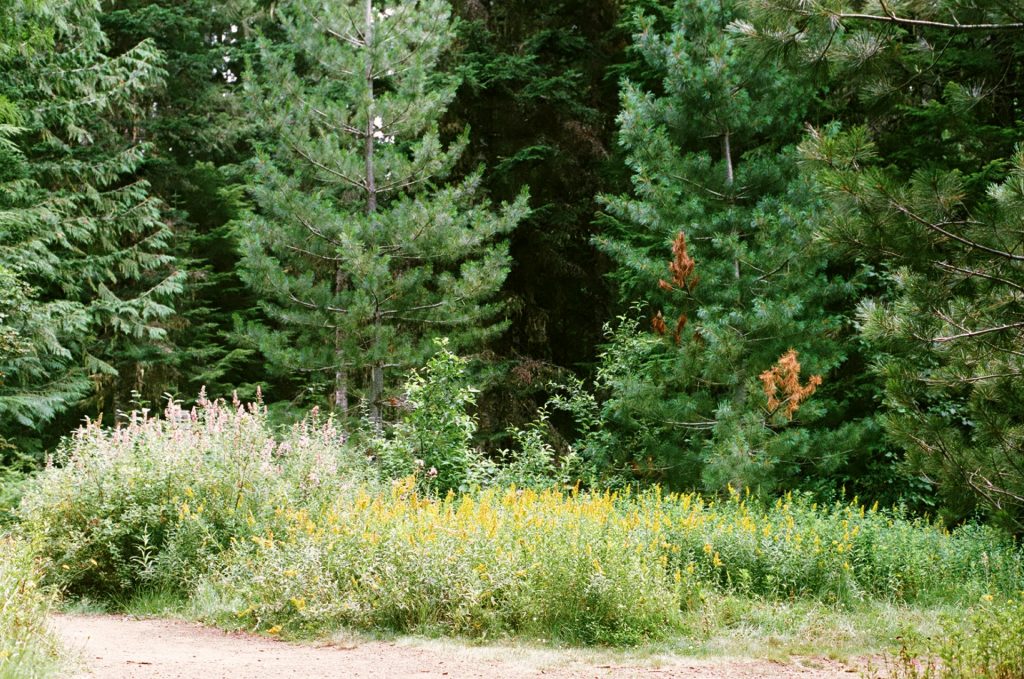
I gathered some kindle for a fire and returned to camp as the sun set. With a small fire burning for my evening meal, I reflected on the kindness of the fellow travelers I had met on the way from Sherwood. Water had been the most substantial challenge on the road, and I was happy to find folks to be so generous with their reserves. A PCT trail angel filled my bottles in the morning, a camper who looked like a thin George R.R. Martin topped me off, and finally a couple in a van gave me a few extra bottles they had as they left camp. I made note to pay this generosity forward and carry its lessons with me back to Tokyo.
As I ate dinner, thunder approached from the east, followed by rain. I moved to my tent to listen to the chorus of raindrops tap tapping on the fly. The rain’s voices lent their magic to my spirit, so I followed them into a wooded patch near camp. I recognized the woods from a dream I had before leaving Tokyo. I weaved through the trees, asking for their mentorship as I traced the specters of my dreaming self. Was this a sign that I was close to finding what I had come for, or had I simply manifest this specific scene and nothing more?
I absorbed the tree elders’ guidance and carried it with me to my dreams.
***
It was many nights and rough travel up to the mountain, where Coyote carried Chief’s wish.
“You have traveled far, Coyote,” the mountain whispered into the wind when Coyote summited. “Why do you seek me?”
“I have come to carry a wish from a village that sits against the river,” Coyote explained. “A terrible disease has visited them and the forest’s herbs have failed to fight it. The villagers are weak and haven’t the strength to gather food. Their Chief, a wise and generous leader, wants to look over her people forever to prevent this terrible disease and other calamities from revisiting.”
Coyote waited for the words to sink into stone and for the mountain to whisper its reply. Mist snaked through the trees and the voices of woodland critters punctuated the passage of time.
“Humans live such short and difficult lives. I will help this Chief by granting her wish.”
Coyote bowed in gratitude to the mountain and waited.
“A stone rests below you, Coyote,” the mountain’s voice echoed in the passing breeze. “Take this stone to Chief and tell her to place it on her chest as she sleeps. When she awakes, her wish will be reality.”
Coyote wrapped the stone in cedar fabric and tied it around his neck. He offered the mountain one last bow of gratitude and began his descent.
When the windy moon gave way to a warm sunrise, Coyote returned to Chief and gave her the stone, along with the mountain’s instructions. They awaited nightfall together, sharing in the food and stories the villagers offered. When night finally came, he positioned the stone on Chief’s chest and said, “Your people have grown stronger, and with the mountain’s gift, they shall never be without you.”
Coyote rose the following morning to see Chief had disappeared in the night. Her voice called him and he followed it to a rock face not far away, where she had taken up her new existence as a silhouette in red stone.
“Thank you, Coyote,” she said. “From here, I can see my entire village and protect them from harm.” The two looked over the great river and the people below. Before parting ways with Chief, Coyote left a branch of sage at her base and thanked her for her strength.
Day 4 — Trillium Lake
I often think it would be much harder to misplace things if only I had fewer things to misplace. Keys lost under a pile of knick-knacks, papers lost in filing books of other papers. But even on the road, with just two panniers, I felt like I was constantly looking for something. On this particular morning, I couldn’t find my remaining breakfast bars for the life of me. Which pocket did I put them in? Mindfulness and intention is as much a problem as abundance.
Some frantic shuffling finally turned up some breakfast in my pack. With that out of my way, I then confronted a more fundamental challenge: what to do with a day of rest. With no climb ahead of me, my mood was light and cheery, and I reminded myself to slow down and make space to be grateful for the beauty of this place.
The prior day’s rain had given way to a blue sky. The morning offered ideal hiking conditions, so I hanged my sleeping bag and some wet clothes to dry, then set out for a walk.
The woods around Trillium Lake have a healing quality, and walking through them, I imagined how much happier I would be if I lived near a place like this. It would be such a blessing to walk among these trees in the morning, rather than among the Tokyo commuter crowds.
Often, during escapes like this, the plans and commitments in the coming days and weeks occupy my thoughts and make me eager to “get back to life,” which is a depressing way to say stop living. This time felt different. Having made space to immerse myself in Nature, I found myself wishing that my trip would never come to an end. Of course, I was ready to be out of the saddle and to cook a proper meal, but in that moment, thoughts of Tokyo brought shortness to my breath and tears to my eyes. After the joy of climbing mountains, bathing in the lake, sleeping by rolling rivers, feeling satisfied and not overwhelmed, what could Tokyo offer me besides stability?
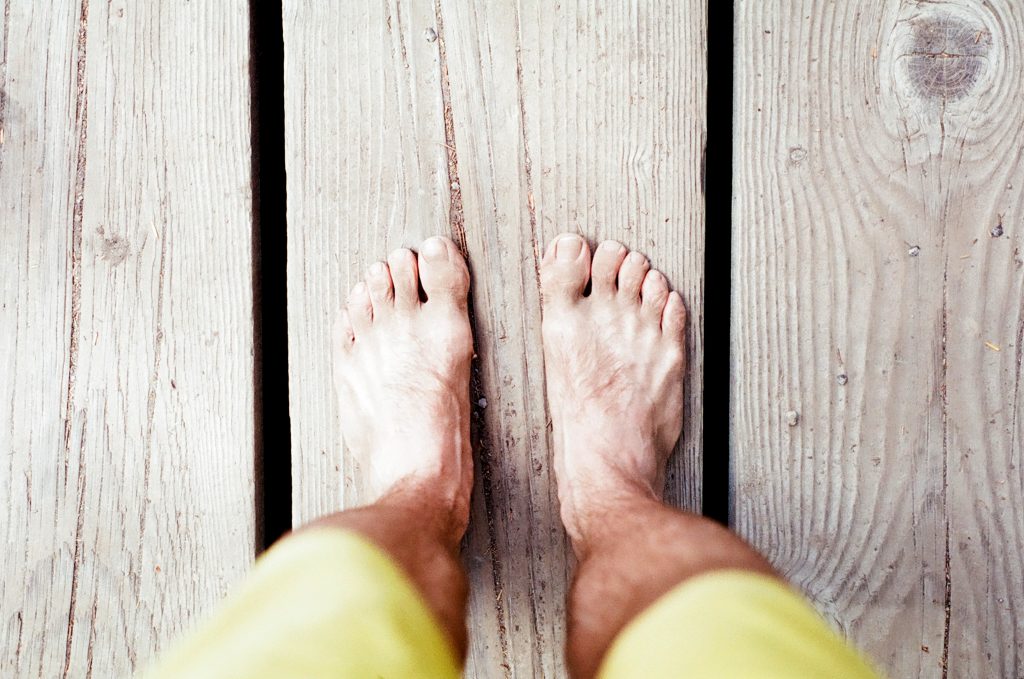
The diversity of Trillium Lake amazed me. Everywhere I looked, someone was looking back — some variety of bird I had never seen, squirrels and chipmunks barking and bouncing hither and thither. And the trees — spruces, firs, alders, birches, cedars. How to hear the wisdom of these sages?
There were friendly people around camp, too. My neighbors, Shawn and Sarah, had recently started living out of a trailer after a professional burn-out, in what felt like an immensely relatable story. They were striving for self-sufficiency, and I asked Shawn about the challenges to achieving it. He told me that water is hard to come by, and I noted that water had been one of my bigger challenges on the trail, too.
Shawn and I talked about some of the encounters a person makes while on the move. He said that some folks who drop anchor in the parks seem “sketchy.” All manner of people had been kind to me in my travels, so I thought it might be a betrayal of their kindness to agree with him. “Well, if they’re out, here they must be running from something,” I replied, and it seemed to punctuate the conversation.
One such person was camped at the far end of our ad hoc campground. She had spotted me moving some firewood from a vacant site and yelled my way, “You gonna use all of that firewood?” I told her I’d taken my share and would be happy to carry the rest her way.
As I set about moving the cords of fuel to her fire pit, paying it forward as I had learned, she asked me where I was from. I told her that I’m from Indiana, and she said “I was just there, drove through on my way to Washington.” I commented that that’s a mighty long drive and asked her how long she’s been camping. “Oh, I been camping on this spot for years,” she said. Her site told me she wasn’t much of the outdoor type, or ruggedly self-sufficient like Shawn. It looked like a car was home for her.
I asked her if she had enough food, and she told me that she was fine on provisions. She started talking about her firepit burrito recipe. “That sounds delicious,” I replied. “I’m mostly eating instant stuff out here.” She told me that instant ramen and coffee are her diet, too, “but sometimes you have to eat real food.”
The food discussion and the old, beat-up Mercury Sable that likely served as her home told me this fellow traveler might be of the “sketchy” type, but that didn’t make her less kind. We’re all here for a reason and maybe it’s best to assume no one person’s reason is any better or worse than another’s.
I told Shawn that I had biked up to Trillium Lake from Portland, and he told me that it was impressive. At the expense of seeming disagreeable to Shawn, who showed me all kinds of generosity, I didn’t think the work I had escaped to complete should impress anyone — with the important exception of myself, who overcame so many spiritual limitations.
No, Shawn seemed much more impressive to me. I came for a five-day crash-course pilgrimage. Shawn and Sarah, by contrast, had the courage to leave behind stability for a life on the road.
As I considered this, thunder returned for a second evening. It was persistent and the sun eventually tired of its frequent but brief attempts to chase off the clouds. By the time the rain had finally started falling, I had moved the firewood and other supplies to shelter.
The rain continued for an hour, which I occupied by writing from the comfort of my tent. After the sun returned, I I set out to forage for an afternoon snack and for some birding. These activities keep me engaged until the sunlight began to wain, at which time I set a fire and put some dinner together.

On my last night in the wilderness, I sat in the light of a full moon and sang songs to myself. I reflected on the strength and courage it took to get from Tokyo to this place. I pushed away the difficult decisions that awaited me on my return and took time to appreciate my tiny role in the universe.
***
“I heard how you’ve helped our fellow forest-dwellers in the North,” the bear said to Coyote as the two shared each other’s company under a starry sky. “You are a clever and generous friend to all.”
Coyote appreciated the bear’s kind words, but detected a hint of sadness in them.
“It is a great privilege to be able to assist, but I must admit to some concern about an unspoken sadness you seem to have, bear. What troubles you?”
The bear’s eyes communicated her great surprise. Coyote indeed had developed a reputation for his diplomacy, but it seemed even the stories had fallen short of conveying his great empathy.
“You are most intuitive, as well,” the bear praised Coyote once again. “My heart aches because my brother has left this world. He rests in the stars now.”
The bear pointed her massive paw upward at each of the stars that traced her brother’s spirit in the sky.
“What I would give to join him,” she added, then dropped her head and sighed as she sank into her heart’s longing.
Coyote drew closer to the bear and felt the waves of her hot breath. He looked to the sky, then back to her.
“Bear, I think I may be able to take you to your brother. But you must know that once in the heavens, you cannot return. Please make yourself ready and come back to this place on the new moon, when the fire of these stars burns brightest.”
The bear was overjoyed and accepted Coyote’s offer. They went their separate ways the next morning and returned some nights later, under the new moon.
“Coyote, I am ready to see my brother,” the bear said, and a tear came to her eye.
“And I am ready to see you off, friend,” Coyote replied. Then, he set about his plan. Pointing a bow toward the sky. He loosed an arrow and watched it fly above their heads and stick with a thwang. He repeated this many times, going higher and higher until the arrows reached far into the night sky forming a towering stairway.
Coyote started up the stairway and motioned for the bear to follow him, which she did reluctantly. The two climbed deep into the night and finally reached the brother’s spirit.
Brother and sister embraced and cried in each other’s arms.
“When the sun rises, you will become a part of this great tapestry of stars, along with your brother,” Coyote told the bear. “I must remove these arrows as I descend, so please be sure that this is your heart’s desire.”
Without hesitation, the bear nodded and smiled a wide smile. She thanked Coyote and sent him on his way.
Coyote reached the woods, his arms full of arrows. He looked up to see the two bears’ spirits traced by stars, their tears a great river across the night sky.
Day 5 — The Descent
After a restful night, I awoke to a cold, gray morning. I wasted no time packing my panniers for the return leg, then I wrote a thank you letter to Shawn and Sarah for their generosity and company. Finally, I thanked the land for its shelter and the lessons it imparted. With that, I pointed my handlebars in the direction of Portland.
I took the back route out of Trillium Lake, which proved to be a good decision for the encounters I had along the way. When I finally reached the exit, where the gate meets Highway 26, a jack rabbit was waiting to see me off. I took that to be a good omen for the journey ahead.
To be short, I was wrong. Shortly after I started the descent on Highway 26, it started raining. Soon, it went from raining to pouring. The conditions were treacherous for a speeding descent. Perhaps my lagomorph pal was trying to warn me to wait out the storm.
So, the jack rabbit’s warning went unheeded, and I was in for a penny, in for a pound. I fought strong headwinds, slippery roads, and limited visibility for the first two-thirds of the road into Sandy. I was cold, wet, and tired from tensing at my brakes.
Signs of so-called civilization first appeared around Zig-Zag — a Dairy Queen, a gift shop, campers in luxury cars making their own returns. Then came the rubbish. Being in the pristine wilderness around Trillium Lake had diminished my tolerance to litter, so I felt my hackles rising as I sped past discarded food containers, plastic bottles, and so on.
By the time I reached Sandy, the sun had emerged. I stepped into a diner and stepped, changed into some dry socks, and ordered a black coffee to warm my stomach. Generic country tunes filtered through hushed conversations. The National Cornhole Championship, which I was stunned to learn is a thing, played muted on the 52-inch TV in the corner. I wanted to return to the wilderness.
The rest of the ride into Portland is easy in the sense that it’s relatively flat and there’s not too much car traffic. I consult my map frequently, particularly as I approached Portland city limits. In the early afternoon, I reached Everybody to return my gear, unloaded my panniers, and moved to the room where I was put up for the night.
At my room, I took a shower, hanged my tent and sleeping bag to dry, then grabbed a book and set out to explore Portland. The lessons I learned on the road bubbled up as I read in a nearby watering hole.
Lessons I would take with me back to Tokyo.
Lessons that would point the way forward.
***
I sat beside Coyote looking out at the setting sun.
“Coyote, I have read about your wisdom, and about the many things you did for the people that stewarded this place before me. I’m lost and could use your guidance.”
Coyote considered for a moment, then turned and asked, “Where is it you’re trying to go?”
“It’s not a place,” I said. “I mean, it might be. I just want to feel happiness.”
Silence passed between us again. The sun sank finally behind the trees and stars began to surface in the liminal sky.
“I’m confused, human. You claim to have heard stories about my good deeds. I expect you know how I helped a starving village by mentoring my beaverfriends to respect the river’s will and share its abundant blessing. I expect you know how helped the chief who longed to be a better guardian of her people. I expect you know how I helped return sister bear reclaim her friendship with her brother.”
I nodded along in turn as Coyote recounted the tales. Each one I had read, and each I had considered as I cycled and hiked my way through these woods.
“If you know these stories, then you have everything you need to be happy.”
I navigated Coyote’s guidance like a maze, exploring corners of the stories I learned. The non-human world speaks to us in so many ways, but we struggle to interpret the messages they give us.
“You have it within yourself to be a mentor, a guardian, and a friend,” Coyote continued. “Be these things where it matters, and happiness is yours.”
With no more to be said, Coyote and I sat in silence, under the watchful gaze of bear and her brother walking across the sky.
Days, Numbered
Before departing on this pilgrimage, I set an intention to find direction in my life. I thought Oregon might be a new place to call home — a place where I could finally invest my time and energy in important dreams and relationships.
That so much happenstance conspired to bring me to this journey is a strong positive signal. The Rockaway Beach tide pools made silver by a rising moon, the majestic waterfalls that encouraged me along the Columbia River Scenic Highway, Mt. Hood and its wonderful greeting as I rounded Bennet Pass, fellow travelers on the trail — these beautiful friends I met and the stories they share add to the area’s appeal.
Having more time would also be a great luxury afforded by a relocation outside Tokyo. So much of the average Tokyoite’s time is expended on commuting to jobs that start too early and end too late. The only time a person can find to rest is on the weekend. In truth, I had become so accustomed to this pattern that I was anxious about having so many unplanned and uncommitted hours to myself. Would I find that I’m a boring person, unable to occupy myself if not in the service of someone else?
I was pleased to find that leisure was actually quite rewarding. In addition to the countless ways Nature entertains, I also found myself engaged in so many projects throughout the day. For example, Shawn and I cooperated to relieve a tree that had been bound by some careless camper’s wire. It was such a satisfying task. It was meaningful work.
This pilgrimage was meaningful for so many reasons. I keep returning to the lessons it taught me about my role in our shared time. Mentor, guardian, friend.
My project moving forward is to align my life more closely with these roles.
Acknowledgments
The coyote stories in this trek journal are adapted from the legends of the Chinook Nation, whose citizens traditionally stewarded the land around Mt. Hood and Columbia River. They are incorporated here with deep gratitude and respect for the Chinook.